Radiant Floor Heat Running Too Hot? Causes & Fixes
Radiant floor heat running way too hot? Learn common causes, what you can safely check yourself, and when it’s smart to call in a pro for your system.
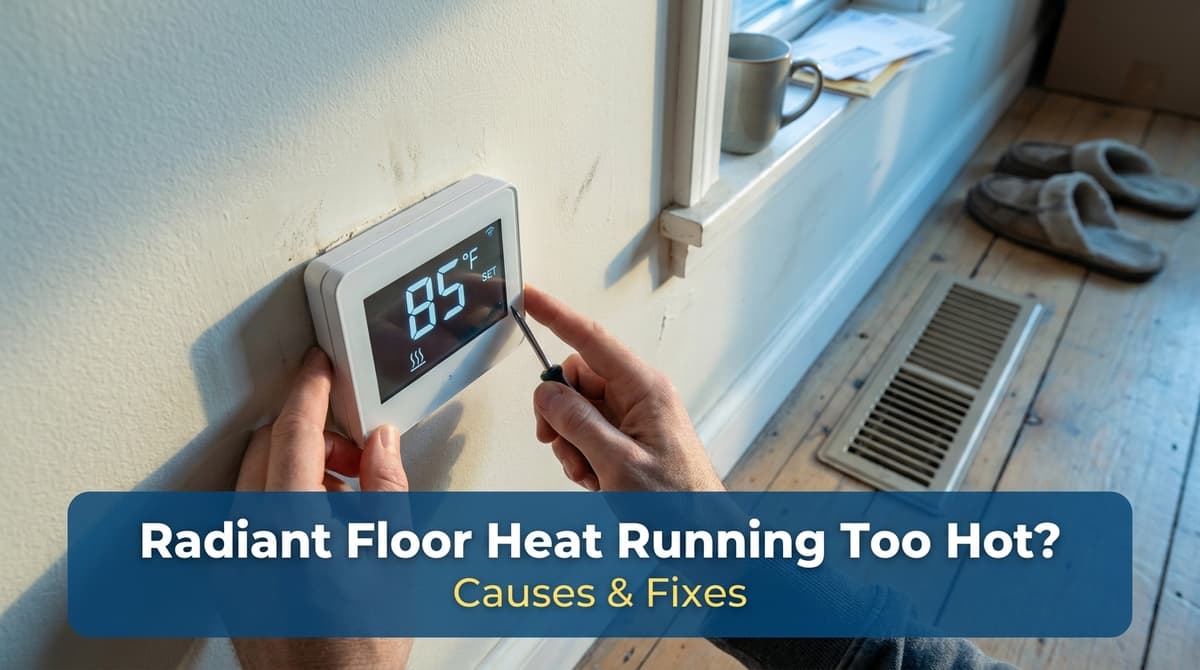
Radiant Floor Heat Running Too Hot? Here’s What We Check
We recently got a call from a homeowner — let’s call her Lisa — who had just moved into a new place with radiant floor heat. She turned the system on for the first chilly weekend, set all the thermostats to 62°F… and the house shot up to 76°F and just kept climbing. The floors wouldn’t stop heating, so she shut the whole thing off and switched to her wall-mounted mini-splits and gas fireplaces instead.
Her big questions were ones we hear a lot: “Is something wrong with the boiler? Is it the thermostats? Should I leave it on before you come? Is it even safe to run?” If your radiant floor heat is running way too hot or simply not shutting off when it should, you’re not alone — and there are some common culprits we look for first.
Why Radiant Floors Can Overshoot the Thermostat Setting
Radiant floor heat feels different from forced air, and that can confuse things. Even when everything’s working perfectly, there’s a natural “lag”: the floor warms up, then the slab or subfloor holds that heat and keeps releasing it, even after the boiler or heat source shuts off. So sometimes the room will drift a couple of degrees warmer than the thermostat setting.
But in Lisa’s case, the thermostats were at 62°F and the home hit 76°F. That’s more than a normal lag — that’s a sign the system isn’t responding correctly to the controls. When we hear that kind of overshoot, we start thinking about:
- Thermostat issues (wrong type, bad sensor, miswired, or just failed)
- Control problems (zone valves or pumps stuck on)
- Boiler or mixing valve running water that’s too hot
- Improper system setup by a previous installer
Simple Things You Can Safely Check Yourself
Before we even schedule a visit, we often walk homeowners through a few basic checks over the phone or by texted photos. That’s exactly what we did with Lisa.
1. Double-check the thermostats
Start with the obvious, indoors:
- Make sure they’re in “heat” mode, not “off” or “cool.”
- Confirm the set temperature really is what you think it is (no hidden schedules or setbacks overriding your setting).
- See if the display looks normal: any error codes, flashing icons, or blank screens?
- Compare room temp readings against another thermometer. If the thermostat thinks the room is 60°F when it’s actually 72°F, the sensor may be off.
If the thermostat is turned way down and the floors are still heating hard after an hour or so, the problem is usually beyond the thermostat itself.
2. Listen for equipment that won’t shut off
Head to wherever your boiler or radiant manifold is located. Without taking anything apart, just listen and look:
- Is the boiler firing constantly even when all thermostats are turned down?
- Are the circulation pumps running nonstop? You can usually hear or feel a gentle hum or vibration on the pump housing.
- Do any pipes feel extremely hot to the touch (be careful) when the system should be “off”?
When Lisa called, she wasn’t sure what brand of boiler she had, so we asked her to text a couple of pictures. That helps us identify if we’re dealing with a boiler that uses zone valves, zone pumps, or a manifold with actuators — all of which can stick in the “open” position and keep sending heat even when they’re not being told to.
Common Technical Causes of Overheating Radiant Floors
Once we’re on site, there are a few usual suspects we check pretty quickly.
1. Thermostat or sensor problems
A radiant system might use:
- A standard wall thermostat measuring room air temperature
- A floor sensor (buried in the floor) to limit floor temperature
- Or a combination of both
If the thermostat is wrong for the system, wired incorrectly, or the floor sensor has failed, the boiler may never get the message to shut off. We’ll test the thermostat, check wiring, and verify it’s the correct style for radiant heat.
2. Stuck zone valves or circulator pumps
In hydronic radiant systems, each zone (area of the house) is usually controlled by a valve or pump. When the thermostat is satisfied, that device should close or shut off. If it sticks open or on, hot water will keep flowing through the floor loop, and the room temperature will keep climbing.
We’ll manually operate valves, test pump relays, and confirm each zone actually shuts down when the thermostat says “enough.”
3. Water temperature set too high
Radiant floors typically run on lower water temperatures than baseboards or radiators — often in the 90–120°F range, depending on the design. If a mixing valve is misadjusted or bypassed, the floors might be seeing much hotter water than they’re designed for.
That can make the floors feel uncomfortably hot and push room temperatures far above the setpoint. We’ll check the boiler’s supply temperature and any mixing or tempering valves and dial them in to match the system design.
4. Control logic or wiring errors from previous work
In homes like Lisa’s, where the previous owner had a list of different service providers, we sometimes find “creative” wiring or control setups. A thermostat might be tied into the wrong zone, or a boiler control might be programmed incorrectly so it thinks there’s always a call for heat.
In those cases, the fix is part detective work, part cleanup: tracing wiring, labeling zones, and reprogramming controls so each thermostat actually controls the right area.
Is It Safe to Run the System Until We Visit?
Lisa asked another smart question: “Is it helpful to have it turned on and fully operating when you come? Should I run it for a day or two beforehand?” In her case, we told her to leave it off until we arrived.
If your radiant heat is overshooting the setpoint by 10+ degrees or making the house uncomfortably hot, it’s usually best to turn the system off at the thermostat or boiler switch and use backup heat (mini-splits, fireplaces, or space heaters used safely) until we can diagnose it.
We don’t need the system preheated for a day or two — in fact, that can just make the house miserable and waste energy. We can turn everything on, test it step-by-step, and see what’s happening in real time during the visit.
When It’s Time to Call a Pro
A little bit of temperature drift is normal with radiant floors, but if you’re seeing big swings like Lisa did, it’s worth having a professional take a look. You should definitely bring in a professional if:
- The house is getting more than a few degrees warmer than the thermostat setting
- The boiler or pumps seem to run constantly, even when thermostats are turned way down
- Floors feel too hot to comfortably walk on for long periods
- You’re unsure what kind of boiler or controls you have and don’t feel comfortable poking around
A seasoned tech can usually narrow down the problem pretty quickly with some basic testing, especially if you can text or email a few clear pictures of the boiler, manifolds, and thermostats beforehand. That’s often how we prep for a visit so we show up with the right parts and tools.
Need Help with a Radiant Floor That Won’t Cool It?
If your radiant floor heat is running too hot, not shutting off, or just not behaving the way you expect, we’re happy to help you sort it out. We’ll walk through a few simple checks with you, then come out, diagnose the real cause, and get your system running safely and comfortably — before the next cold snap has everyone calling at once.