Radiant Floor Heat in Existing Homes: Hydronic vs. Electric
Replacing floors and considering radiant heat? Here’s how to choose hydronic vs. electric, when you need load calculations, and the best install options on a subfloor.
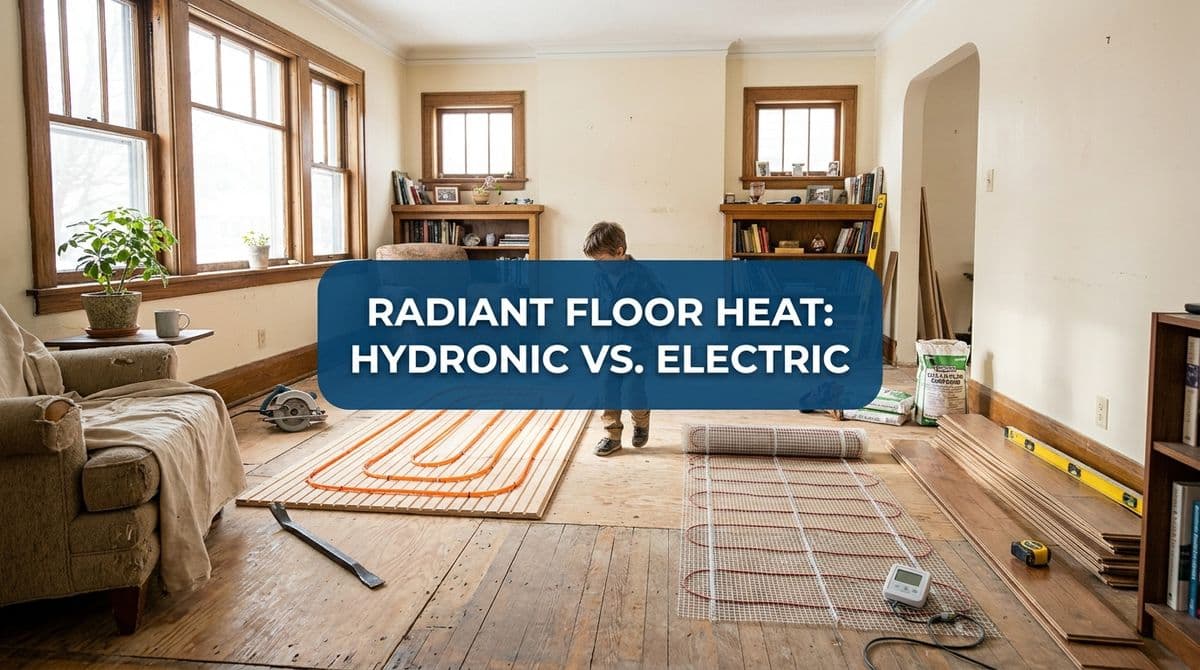
Planning Radiant Floor Heating During a Remodel
We recently got a call from a homeowner — let's call him Kevin — who was right in the middle of a flooring project. His old floors were torn out, he was down to the subfloor, and he said, “If I'm ever going to add radiant floor heat, this is the time, right?” He was exactly right.
Kevin wanted to save some money by doing part of the work himself, but he had a lot of good questions: hydronic vs. electric, whether he needed a heat loss calculation, and how you actually install radiant when you're working with an existing subfloor instead of a brand-new concrete slab.
If you're in a similar spot — floors coming out, looking at that bare subfloor and dreaming of warm toes — here's how we walk homeowners through the options.
Hydronic vs. Electric Radiant: What's the Difference?
When Kevin called, his first question was about “hydroponic, or whatever it's called.” The word he was looking for is hydronic, and that's one of two main types of radiant floor heat:
- Hydronic radiant: Uses warm water in PEX tubing under (or in) the floor.
- Electric radiant: Uses electric heating mats or cables under the floor.
When Hydronic Radiant Makes Sense
Hydronic is what we typically recommend when:
- You're heating a large area or whole house.
- You already have (or plan to add) a boiler or high-efficiency water heater designed for radiant.
- You want radiant to be your primary heat source, not just floor warming.
Hydronic systems can be very efficient long-term, especially in colder climates, but the design and install are more complex. That's why Kevin asked about “load tests and design and all that.” For hydronic, we usually do a detailed heat loss calculation (Manual J) and a loop layout to get it right.
When Electric Radiant Is a Better Fit
Electric radiant mats are often the better choice when:
- You're heating smaller areas (bathrooms, kitchens, entryways).
- You're working with an existing subfloor and don't want extra weight or height.
- You want simpler installation and lower upfront design costs.
With Kevin, once we realized he was on a framed floor (not a slab) and the home wasn't designed for heavy concrete overpours, we walked through electric mats as a practical option. As I told him, you typically don't need a full heat loss report for electric floor warming — the manufacturer will size the mats based on your room dimensions and layout.
Do You Really Need a Load Calculation (Manual J)?
Kevin asked straight out: “Do you do design and load tests and all that?” That's a smart question, because not every radiant project needs the same level of engineering.
When a Heat Loss Calculation Is Essential
We insist on a proper Manual J heat loss when:
- The radiant system will be your primary or only heat source.
- You're doing a whole-home or large-area hydronic system.
- You're integrating with other systems (radiators, air handlers, etc.).
A heat loss calculation tells us how many BTUs per hour each room needs on the coldest design day, so we can size tubing, water temperatures, and manifolds correctly. Without that, you're guessing — and guessing on radiant usually means cold rooms or high energy bills.
When You Can Skip the Full Manual J
For most electric floor warming projects (especially small rooms), you can usually rely on:
- Manufacturer's layout and sizing tools.
- Simple square-footage-based rules.
- Basic electrical load checks by your electrician.
That's why, for Kevin's situation, I explained that if he went with electric mats, we likely wouldn't need to run a full Manual J. Instead, the key is making sure your electrical panel can handle the added load and that the circuits are sized and protected correctly.
Installation Options When You're Replacing Floors
Kevin's timing was perfect: “There's no floors in it right now. I'm looking at getting it done before we put new floors in.” If that's you, here are the main approaches we look at.
1. Overpour (Best on Slabs or Engineered for Weight)
I mentioned to Kevin the “gypsumcrete” option. With hydronic radiant on a slab, the best way is often:
- Lay down PEX tubing.
- Pour about 1½ inches of gypsum-based concrete over it.
- Finish with your final flooring on top.
The catch? That overpour usually adds around 7 pounds per square foot. If your house wasn't engineered for that weight, adding it to a framed floor can be risky. That's why I told Kevin his existing structure likely couldn't handle an overpour — and we needed to look at other options.
2. Under-Joist Hydronic (From Below)
On a framed floor with a crawlspace or unfinished basement, one method is to install tubing under the subfloor between the joists:
- Pull down or remove existing insulation.
- Fasten radiant plates/tubing to the underside of the subfloor.
- Reinstall insulation beneath the tubing to push heat upward.
This avoids extra height and loading on top of the subfloor, but it's more labor-intensive and requires good access from below. It can work well for hydronic systems when overpour isn't an option.
3. Electric Mats on Top of the Subfloor
For Kevin, we spent some time on electric radiant mats. The sequence usually looks like this:
- Prepare the subfloor (clean, flat, secure).
- Lay out electric mats per the manufacturer's plan.
- Have an electrician handle wiring, thermostat, and circuit protection.
- Install thinset and tile, or self-leveling compound plus your chosen floor covering.
Kevin was comfortable doing some of the physical work himself but didn't want to guess on “amps and all that.” That's exactly the point where we bring in a licensed electrician to:
- Confirm panel capacity and breaker sizing.
- Run dedicated circuits where needed.
- Install GFCI protection and the thermostat.
DIY vs. Pro: Where to Draw the Line
Kevin's goal was to save money by doing part of the install himself. That's very possible, especially with electric systems, but there are smart boundaries:
- Good DIY tasks: pulling old flooring, prepping subfloors, laying out mats or tubing under supervision, replacing insulation, documenting room measurements.
- Pro-only tasks: system design and heat loss for hydronic, boiler or manifold installation, electrical wiring and breaker work, pressure testing hydronic loops.
If you're not sure where your line should be, we're happy to walk through it with you. The goal is to let you do what you're comfortable with, while we make sure the parts that affect safety, structure, and performance are done right.
Thinking About Radiant While Your Floors Are Out?
If your floors are already torn up, you're at the ideal stage to make decisions about radiant heat. Whether you're leaning toward hydronic or electric, the big questions are:
- Is this whole-home heat or just floor warming?
- Can your structure handle added height and weight?
- What's your electrical or boiler capacity?
- How much of the work do you realistically want to DIY?
If you'd like help sorting through those decisions, we can look at your home, run the right calculations where needed, and design a system that fits your budget and your comfort goals — before that new flooring goes down for good.