Heated Driveways for Existing Homes: Retrofit Guide & Costs
Thinking about heating your existing driveway? We explain how retrofit snow-melt systems work, what they cost, and when they actually make sense.
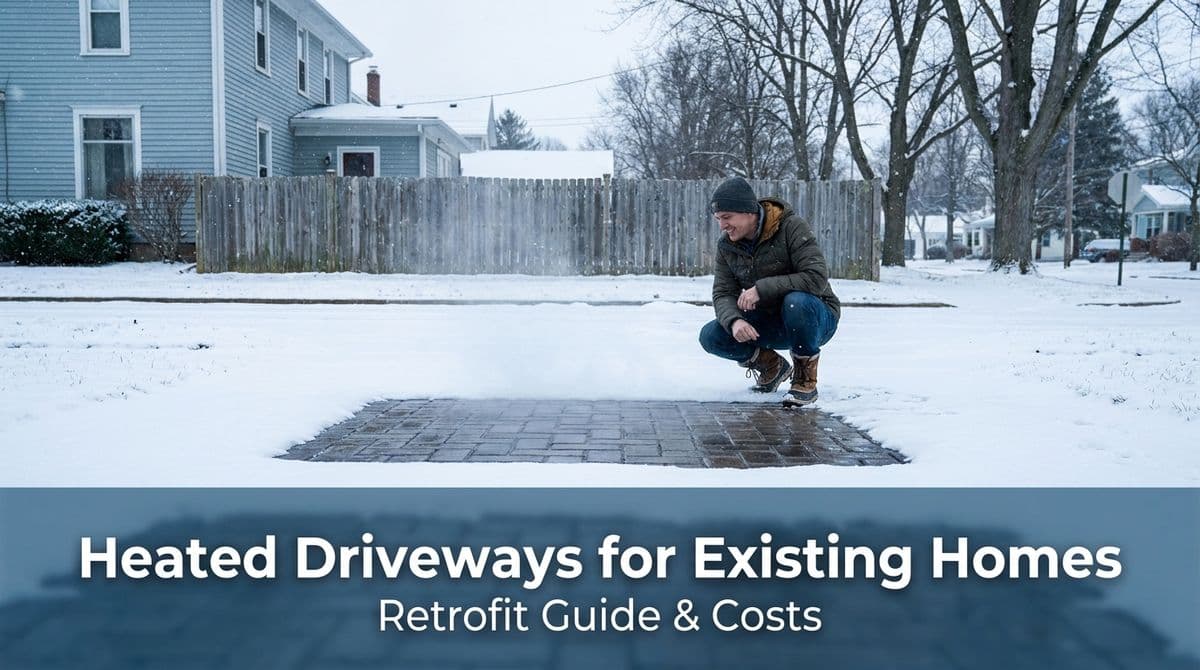
How One Steep Driveway Got Us Talking About Retrofit Snow-Melt Systems
We recently got a call from a homeowner — we’ll call him Mark — who owns a place here in North Idaho with a long, steep driveway that winds up to the garage. He was calling from out of town, nobody was at the home, and winter was on his mind.
Mark asked us if we could install a heated driveway on his existing concrete. He wasn’t building new; the driveway was already there. He just wanted to stop shoveling and avoid the “skating rink” effect when snow on that steep drive turns to ice.
We told him what we tell a lot of customers: yes, we absolutely do retrofit heated driveways. But we also needed to send one of our techs by to see the driveway, check where the gas line and electrical are, and look for a spot in the garage for the boiler and controls. That on-site look is always our first step whenever we design a snow-melt system for an existing home.
How Retrofit Heated Driveways Usually Work
When we talk to homeowners about heating an existing driveway, we walk them through the two main options we typically design:
- Hydronic systems – plastic tubing in the driveway carrying warm water/glycol from a boiler
- Electric systems – heating cables embedded in the concrete or pavers
In Mark’s case, we were especially interested in his gas line and garage layout. He mentioned there was a natural gas connection and a Generac generator on the side of the garage. That’s good information for us, because a gas line nearby often makes a hydronic boiler a strong option.
What we look for on an existing driveway
Whenever we retrofit, we don’t just guess over the phone. We usually send a tech out to:
- Measure the driveway size and slope
- See how close gas and electric are to the driveway
- Find a good spot in the garage or mechanical room for the boiler, manifolds, and controls
- Check drainage and where meltwater will go
For a hydronic system, we’re planning space for the boiler, pumps, manifolds, expansion tank, and controls. For electric, we’re planning the route to the panel and verifying there’s enough electrical capacity. That’s why we asked Mark if we could get into his garage — we like to see where everything can realistically live before we quote anything.
Hydronic vs. Electric: What We Usually Recommend
We design both types of systems, and we don’t believe in a one-size-fits-all answer. Instead, we explain to homeowners where each system tends to shine so they can decide with us.
When we usually recommend hydronic snow-melt
We often lean toward hydronic systems when:
- The driveway is large or steep (like Mark’s)
- Natural gas or propane is already on site
- You want the most efficient option for big surface areas
- You’re okay with a little more mechanical equipment in the garage
Hydronic systems circulate heated fluid through tubing under the driveway. The boiler can be gas, propane, or even high-output electric in some situations. For a long, steep driveway in a snow-heavy area, this is often what we suggest because operating costs tend to be lower over time.
When we usually recommend electric snow-melt
We typically recommend electric systems when:
- The area to be heated is smaller (walkways, short flat drives, steps)
- There’s no convenient gas line and adding one would be expensive
- The homeowner wants a simpler installation with no boiler
- The main goal is spot-melting at key points, not the whole driveway
Electric systems can be a great fit for small or medium areas, but for a long, steep driveway like Mark’s in a cold climate, we usually run the numbers carefully with the homeowner so they understand ongoing power usage.
What a Retrofit Heated Driveway Typically Costs
Costs vary a lot based on your driveway’s size, the type of system, and how much demolition and concrete work is involved. When we break it down for our customers, we usually explain it in three parts:
1. Driveway demolition and replacement
For existing concrete or asphalt, we almost always need to remove and replace it so we can place tubing or cables correctly. That means:
- Demo and haul-away of the old surface
- Base prep, insulation, and reinforcement
- New concrete or asphalt pour over the snow-melt system
On a long, steep driveway like Mark’s, this is often the biggest line item. Homeowners are sometimes surprised that the concrete work can cost as much or more than the heating equipment itself.
2. Snow-melt equipment and installation
For a hydronic system, we’re including:
- Boiler (gas, propane, or electric)
- Piping, manifolds, pumps, valves, and controls
- PEX or similar tubing laid out under the driveway
For an electric system, we’re including:
- Heating cables or mats
- Controls, sensors, and contactors
- Wiring to your electrical panel
We walk customers through these components during the quote so they know exactly what they’re paying for and where it’s going.
3. Gas and electrical connections
On Mark’s call, he mentioned gas was already right by the garage. That’s great news for a retrofit because:
- We may be able to tie the boiler in without a long gas run
- We can keep most mechanical equipment near the garage where access is easy
If gas or electrical service needs to be upgraded or extended, we explain those costs upfront so there are no surprises once the concrete is torn out.
When a Heated Driveway Retrofit Makes Sense
We’re big believers in being honest about whether a snow-melt system is worth it. We usually tell homeowners a retrofit makes the most sense when:
- You have a steep or long driveway that’s genuinely hazardous
- You’re already planning to replace the driveway soon anyway
- Snow removal costs or time are getting out of hand
- Accessibility or safety (slips, mobility issues) is a major concern
If your driveway is short and flat and you don’t mind a bit of shoveling, we’ll usually recommend spot-melting (like just the walkways and steps) or even sticking with traditional snow removal.
Thinking About Heating Your Own Driveway?
If you’re looking at your driveway and thinking about a heated system, we’re happy to do what we did for Mark: stop by, measure everything, look at your gas and electric, and give you a clear, itemized quote. From there, we can decide together whether a retrofit snow-melt system is the right move for your home and your budget.